
Air fuel ratio measurement
AEM Wideband Air Fuel Ratio Gauge Kit
An AEM wideband air fuel ratio gauge brings real-time AFR information to a tuning project. The pictured kit combines a dashboard gauge, a wideband oxygen sensor and wiring components; the exact AEM part number and included accessories must be checked from the product label before quotation.
Use an air fuel ratio gauge to observe mixture behavior under the operating conditions that matter to your engine. It provides measurement for a qualified tuner; it does not adjust fueling or guarantee an engine is safe by itself.
Check the gauge kit and sensor →Reading the mixture
Why use a wideband air fuel ratio gauge?
An air fuel ratio gauge displays information calculated from exhaust oxygen measurement. During a tuning session, a wideband O2 sensor lets the operator see how the air-to-fuel mixture changes across idle, cruise, transient and higher-load conditions. A narrowband sensor is designed around a more limited operating range and is not a substitute for a suitable wideband AFR gauge when evaluating mixture away from that region.
The distinction between AFR and lambda matters when fuels change. Lambda expresses the mixture relative to the fuel’s stoichiometric point, while a displayed AFR number depends on the fuel scale used by the gauge. Confirm the selected display mode and the fuel before interpreting a reading. No single AFR target suits every engine, fuel or operating condition.
AEM explains that a UEGO controller and wideband sensor can provide useful AFR information for tuning and that some models offer output to a data logger or engine management system. The available output and scaling must be checked for the exact gauge model. See AEM’s wideband gauge range.
What the buyer actually receives
AEM wideband AFR gauge kit: gauge, sensor and wiring
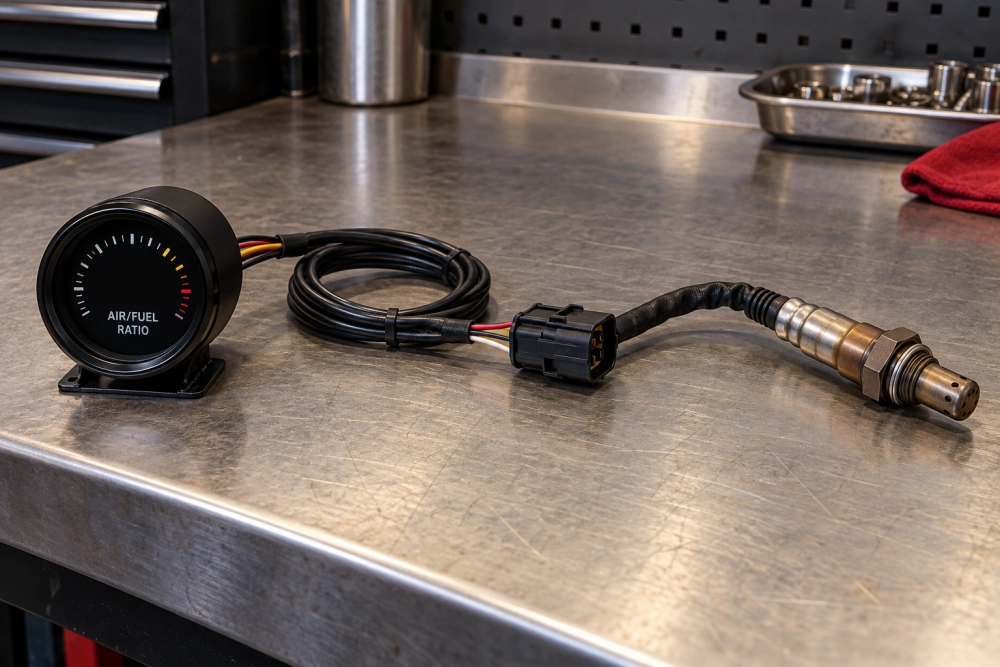
The source photographs show a round AEM AFR gauge, an exhaust oxygen sensor, long wiring cables and small mounting or connection parts. They show a photographed set, but they do not prove that every separately offered item has the same contents. We check the physical components and connector condition against the exact unit available.
| Component | What it does | Confirm before ordering |
|---|---|---|
| AFR gauge/controller | Displays the measurement and houses the controller electronics for the matched sensor system. | Part number, face and bezel, condition, display mode and depth behind the panel. |
| Wideband oxygen sensor | Measures exhaust oxygen for the controller’s AFR or lambda calculation. | Exact sensor family and connector; replacement sensors are not automatically interchangeable. |
| Sensor and power harnesses | Connect the sensor and gauge to the installed electrical system. | Cable length, plugs, insulation condition and any missing accessory. |
| Mounting hardware | Allows installation in a suitable gauge opening and exhaust sensor position. | Bracket, bezel, oxygen-sensor bung and other parts present in the quoted kit. |
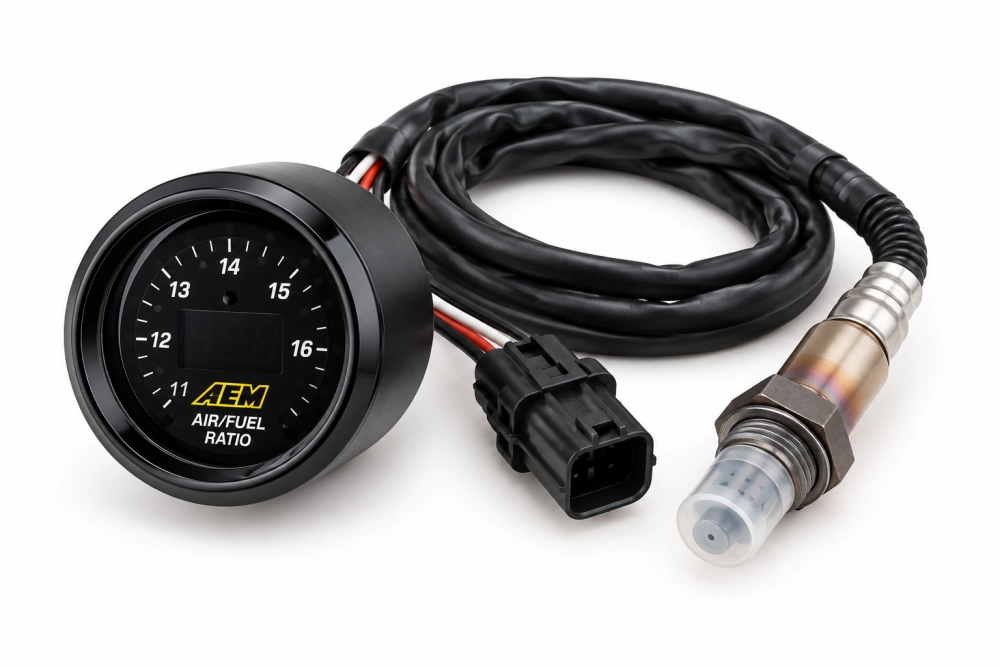
Important: The product listing title says AEM 30-0300, while its description says 30-4100. AEM identifies 30-0300 as an X-Series kit and the older 30-4100 as a different digital UEGO controller with a different sensor generation. We will not assign either model’s precise specifications to the photographed kit until the label and sensor connector are confirmed.
How to compare an AEM wideband O2 sensor kit with a sensor-only listing
Search results for an AEM air fuel ratio gauge often mix complete instrument sets with replacement oxygen sensors, extension cables, faceplates and mounting accessories. A low-priced replacement sensor is not a complete gauge kit, even if its photograph includes an AFR meter for reference. When comparing quotations, ask whether the gauge/controller, matched wideband O2 sensor, sensor cable, power lead, bezel and mounting parts are included. Ask for one current photograph of everything that will ship. This reduces confusion when a supplier offers an AEM wideband AFR gauge kit alongside individual spare parts.
Connector photographs matter as much as a product title. Check that both sides of the sensor connection are visible and that wiring has not been cut or joined in an undocumented way. For a previously opened or older kit, request a powered gauge photograph and a condition statement. A clean photograph alone cannot establish calibration, service history or the condition of an oxygen sensor.
Part number first
How we verify an AEM air fuel ratio gauge model
The name “AEM wideband gauge” describes a product family, not one interchangeable set of electronics and oxygen sensors. A model number on a listing can be mistaken, copied from another product or attached to a photographed earlier revision. A clear label photograph is a more useful starting point.
- Read the gauge or packaging part number. Photograph all labels on the gauge and box.
- Match the oxygen sensor. Photograph the sensor body and its original connector without modifying the plug.
- Check the harness. Count and photograph the power, output and sensor connectors, plus their condition.
- Confirm the installation plan. Tell us the vehicle, available gauge space, exhaust sensor location and whether data logging is needed.
As one example of why the check matters, AEM’s official product information distinguishes its X-Series 30-0300 from earlier digital wideband gauges and warns that the older 30-4100 and later 30-4110 sensor connectors are not interchangeable. AEM 30-0300 reference · AEM Classic series reference.
Practical installation
Installing a wideband O2 sensor and AFR gauge
A qualified installer selects a suitable exhaust location for the wideband oxygen sensor, routes the sensor cable away from heat and abrasion, and provides the gauge with the specified switched power and ground. Exhaust leaks, damaged sensor wires and mismatched connectors can make a displayed value misleading.
After installation, verify warm-up behavior and interpret AFR or lambda only with the correct fuel scale. If an analog output is being sent to an ECU or data logger, the output wiring and voltage-to-AFR calibration must match the exact gauge’s documentation. Do not assume every gauge has AEMnet, RS-232 or the same output scaling.
Where the measurement can help
- Baseline assessment: document how the current engine behaves before changing the tune.
- Piggyback ECU calibration: observe mixture while reviewing selected fuel corrections and engine load.
- Standalone ECU setup: supply a measured AFR or lambda input when the ECU and gauge outputs are compatible.
- Turbo project evaluation: review mixture across relevant boost and transient conditions with a qualified tuner.
- Workshop diagnostics: compare logged readings with other engine and sensor data.
The AEM wideband AFR gauge is a measurement device. For engine management hardware, see our piggyback ECU and standalone ECU pages. For a separate connector or wire-in project, see ECU wiring harnesses.
Choose the right package
AEM wideband AFR gauge buying checklist for ECU tuning projects
A wideband AFR gauge is most useful when the measurement plan is established before purchasing parts. Specify whether the instrument is for a permanent dashboard display, workshop testing or an engine management input. A dashboard project needs an accessible location and appropriate mounting depth; a logging project also needs confirmed signal compatibility. Treat a gauge display, a data logger and an ECU as separate devices whose electrical interfaces must be checked together.
Confirm the air fuel ratio gauge model
Ask for a sharp image of the AEM label, box and gauge face. Use the exact part number to locate the matching installation instructions. The words “AEM wideband” alone cannot establish the sensor type, available outputs or calibration steps.
Confirm the wideband oxygen sensor
Inspect the sensor and plug in a close-up photo. A sensor that physically resembles another version may use different electronics or a different connector. Do not cut or adapt a plug solely to make a mismatched sensor fit.
Confirm the application and quantity
State the vehicle, engine, fuel, intended sensor location, required number of gauges and destination country. If the project uses an AEM F/IC, LINK ECU, Haltech ECU or MAXX ECU, provide the exact ECU version and planned input.
Reading AFR and lambda during a real tuning session
A reading should be interpreted with engine speed, load, throttle movement, fuel type and sensor warm-up state. For example, a brief transient display may not tell the same story as a stabilized measurement under repeatable conditions. Compare the AFR trace with other logged data and check for exhaust leaks or wiring faults before changing a map. Qualified calibration also considers ignition timing, knock margin, temperature and engine hardware. A gauge is a source of measurement, not a substitute for that broader assessment.
For petrol and alternative fuels, lambda can help avoid confusion caused by fuel-specific AFR scales. Tell us what fuel the engine actually uses and whether your tuner prefers lambda or a displayed AFR scale. We can then check which display modes and outputs the confirmed instrument supports without assuming that every AEM air fuel ratio gauge is configured the same way.
Buying questions
AEM wideband air fuel ratio gauge FAQ
Is the pictured kit definitely AEM 30-0300?
The listing title says 30-0300, but the detail text says 30-4100. We need clear photographs of the gauge, box and sensor connector to identify the actual model before quoting model-specific specifications.
Does the air fuel ratio gauge tune the ECU?
No. The gauge measures and displays AFR or lambda information. A tuner uses that information with the appropriate ECU, software and other data to make a calibration decision.
Can I buy only a replacement wideband O2 sensor?
Send the exact gauge part number and photographs of the original sensor and connector. A sensor sold alone is a different product from a complete air fuel ratio gauge kit, and incompatible sensor families should not be substituted.
Can an AEM wideband gauge connect to an AEM F/IC controller?
Some AEM wideband outputs can feed compatible engine management or logging equipment. The electrical connection and output scaling must match the exact gauge and F/IC version; a technician should check both manuals before wiring.
Is a 52 mm mounting hole suitable?
AEM lists 52 mm gauge housings for several wideband ranges. Confirm the actual gauge’s dimensions, mounting depth and holder before cutting or ordering a gauge pod.
What information should I send for a quotation?
Send the product label, sensor connector photographs, the desired quantity, shipping country and whether you want a complete kit or a specific replacement component.
Request the exact package
Ask LikedLinking about the AEM wideband AFR gauge kit
Share the gauge label and sensor connector if you have them. We can check the photographed kit, identify its supplied parts and discuss the correct sensor and wiring for your intended installation.
Request a kit review →